IEM Measurement Artifacts and Oddities

LLKMuffin

New member
One of the aspects of graph-sniffing that tends to trip up a lot of people revolves around recurring odd features in frequency response measurements of IEMs.

This includes features like the two S-shaped squiggles found in B&K 5128 measurements in the mid bass and low mids respectively, or the prominent 8 kHz peak found in IEC 60318-4 (711) coupler measurements.

With enough digging around, you could find out that the former occurs due to "rocking modes" and that the latter is due to the "primary length-mode (quarter-wave) resonance" of the coupler that shifts around with insertion depth.

However, for the vast majority of those that aren't intimately familiar with acoustics, it's likely these words do little to demystify what's physically causing these features to appear in measurements.

The downstream effect of this is that these features are misunderstood to be audible issues, leading to the often observed-in-the-wild "X IEM has a hole in the mid bass" or "Y IEM will sound too harsh, look at this massive 8 kHz peak".

Just thought I'd start this thread to serve as a home for discussions about these features 🙂

I guess I'll start by asking about something that I haven't yet found a good explanation for:

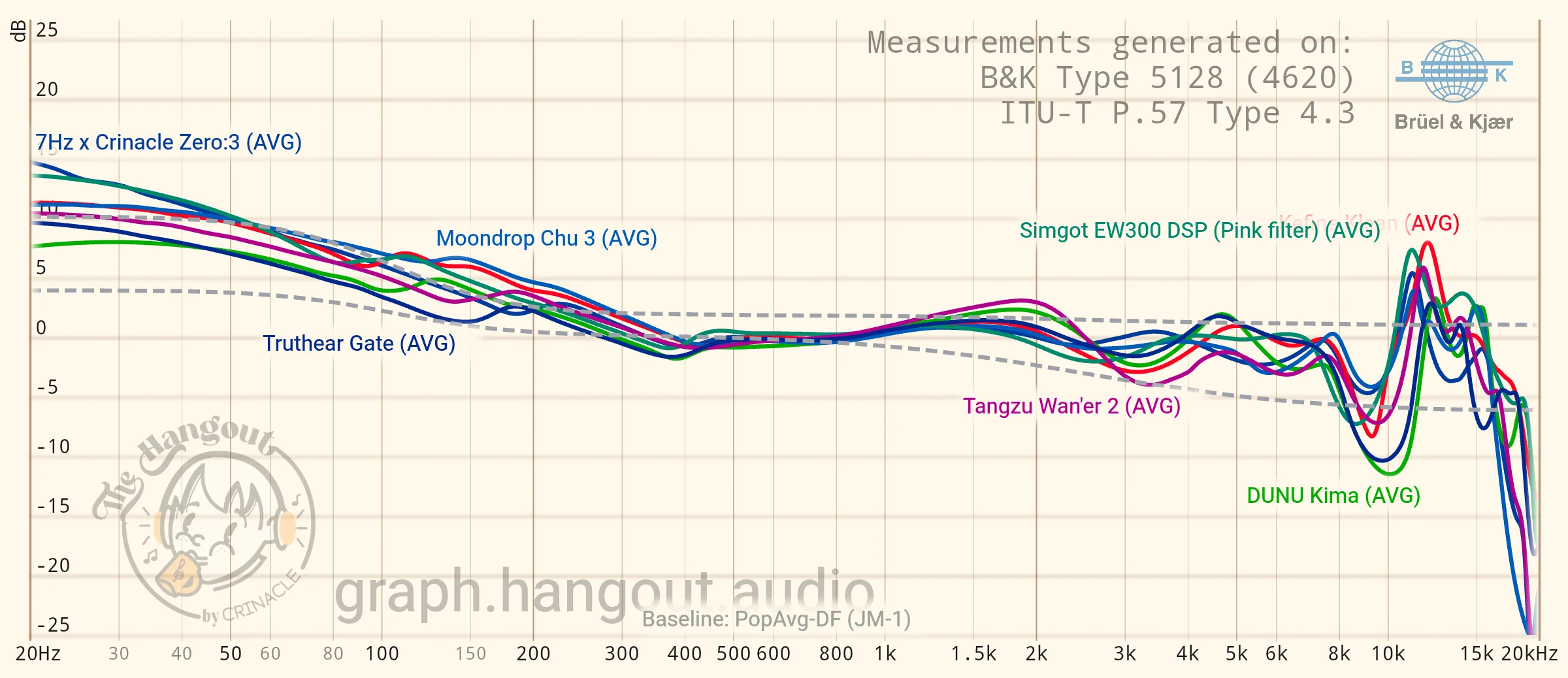
Why do almost all single dynamic driver (and some hybrid driver) sets measure with a chasm in the treble at around 8-12 kHz, followed by a sharp and narrow peak just above that?
1000473863.webp

Various popular single-DD IEMs compensated to JM-1 DF, displayed against Harman preference bounds
​
From what I've seen, this occurs in both 5128 and 711 measurements, but, as far as I'm aware, we don't perceive any such hole + painful peak in the treble when listening to single-DD IEMs.
 
So, some of this may be JM-1 itself. JM-1 is constructed primarily from ISO 11904-1, which has an elevation which starts at ~8khz due to the three-quarter-wave resonance of the open ear canal. In JM-1 it is a relatively smooth elevation, since ISO 11904-1 is an average of humans, and because the data is 1/3rd octave band data. The target expects extra energy at 8khz but that's not where the IEM's resonances are actually falling.

Notably, the HP.com IEM DF does not have this same elevation. Their IEM DF is the same conceptually but is calculated from a measurement of the 5128's canal transfer function and an averaged set of blocked canal HRTFs. I don't know which method is more accurate, and there are issues with both approaches.

The peak at 12khz is likely the full-wave resonance between the eardrum and the IEM. It's hard to check without seeing whether this moves with insertion depth, but this would put the half-wave resonance at ~6khz, which on 711 we aligned to ~8khz. On the 5128 the half-wave resonance seems quite damped but with many IEMs I experience a large peak at about 6k.

but, as far as I'm aware, we don't perceive any such hole + painful peak in the treble when listening to single-DD IEMs.

I'd be careful with that line of reasoning. Every single headphone you've ever heard has likely had peaks and dips in the treble at least that severe. It is an "artifact" in the sense that in your ears the peaks won't fall at the same frequencies, but you can expect deviations in the treble of at least that magnitude.
 
Last edited:
Fantastic idea for a thread! Thanks for starting it.

Why do almost all single dynamic driver (and some hybrid driver) sets measure with a chasm in the treble at around 8-12 kHz, followed by a sharp and narrow peak just above that?
Single driver IEMs' treble responses are operating on simple modal principles with no other sources of magnitude contribution from other drivers, such that what we actually see in their treble response is largely just a function of the mode arising from distance between eardrum and IEM tip (plus, in theory, any breakup modes from that particular driver, but I would assume with most IEM drivers they're sufficiently small that any secondary breakup modes are pushed well into the ultrasonic range).

We'll get peaks around 6-9 kHz which corresponds to the half-wavelength, then one above that at very roughly (because this will change based on the impedance of the shared system between ear and IEM!) double that frequency as it corresponds to the full-wavelength.

RE: the dip that falls between these modes, this is likely a mix of the anti-resonance of the "ear simulator + sound source" system itself, as well as the only source of amplitude from the driver itself coming in the form the aforementioned length-based/impedance-affected modes. You get two peaks above 5 kHz or so, and as would happen with any two narrow peaks spread throughout the FR, you'll get a valley between them 🙂

However, the depth of this valley is affected by how far apart the modes are (which impedance will effect), and how damped the modes are (which impedance will also effect), which is one possible wrinkle that would affect your question below:

as far as I'm aware, we don't perceive any such hole + painful peak in the treble when listening to single-DD IEMs.
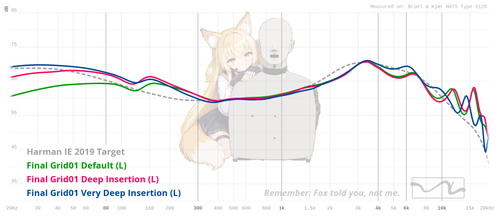
Some people don't perceive them as a dip, but some people do! This will surely be down to, of course, how the distances in play in your ear canal actually affect where the peaks and dips show up, but also how the acoustic impedance of the system affects not only the damping (and therefore, the bandwidth) of peaks, which can make these dips less strong, but also down to how these dips are contextualized versus the HRTF. If someone's HRTF starts to dip strongly around 8 kHz—and some of them may!—this dip may fit neatly into their expectation of timbre and thus may not be heard as a dip.

I would also like to get @oratory1990's input on this in case I'm overextending my understanding of things 😅
 
Last edited:
The peak at 12khz is likely the full-wave resonance between the eardrum and the IEM. It's hard to check without seeing whether this moves with insertion depth, but this would put the half-wave resonance at ~6khz, which on 711 we aligned to ~8khz. On the 5128 the half-wave resonance seems quite damped but with many IEMs I experience a large peak at about 6k.
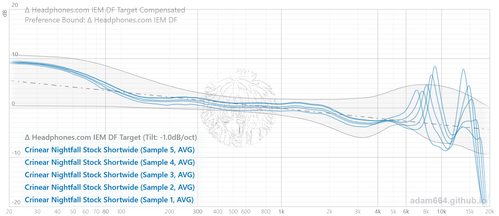
This is my measurment at multiple insertion depths of the Crinear Nightfall which I think is representative of the typical single DD iem in the treble. It is measured wtih a clone 711 coupler.
 
Back
Top